
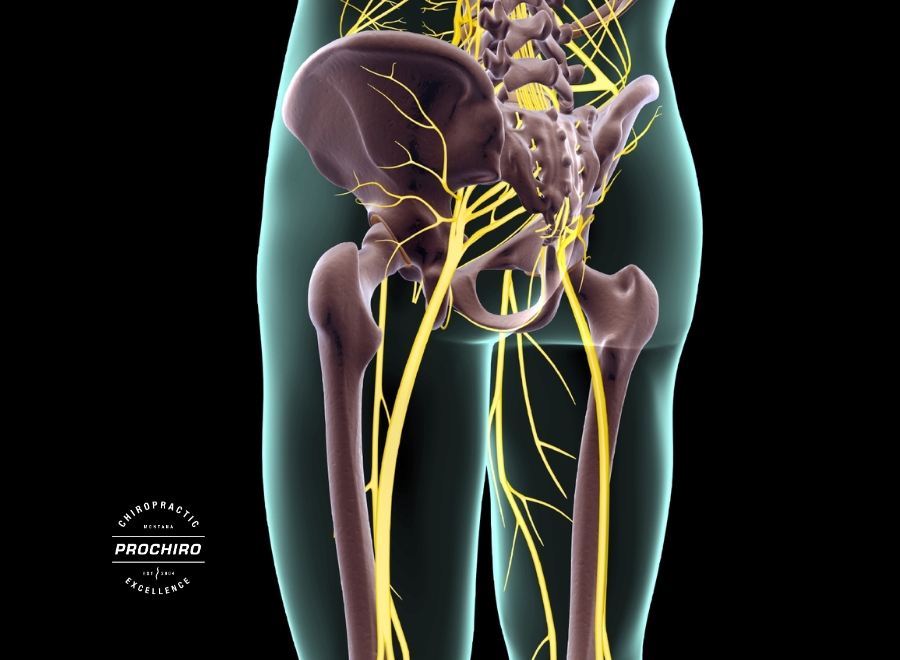
If you’ve been dealing with sharp, shooting pain down your leg, tightness through your hamstring, or numbness and tingling into your foot, you may be experiencing sciatica. This is one of the most common conditions we see at Pro Chiropractic in Bozeman.
Many people try stretching, massage thrapy, or rest, but still find that the pain keeps coming back. That is often because the problem is not just tight muscles. It is irritation of the sciatic nerve itself. One of the most effective and often overlooked ways to address this is a technique called nerve flossing.
What is the Sciatic Nerve?
The sciatic nerve is the largest nerve in the body and plays a major role in how we move and the sensation we have through our lower extremities.
It is formed by several nerve roots that exit the lower portion of the spine in the lumbar and sacral regions. From there, it travels through the glutes, along the back of the thigh, and branches into smaller nerves that extend into the lower leg, foot, and toes.
Because of its long pathway and the number of muscles and joints it interacts with, the sciatic nerve is especially vulnerable to irritation or compression.
When this happens, it can lead to symptoms commonly referred to as sciatica, including:
• Sharp or burning pain down the leg
• Tingling or numbness
• Tightness in the hamstring or calf
• Weakness in the leg or foot
What is Nerve Flossing?
Nerve flossing, also known as nerve gliding, is a gentle and effective technique used to improve the mobility of a nerve.
Instead of aggressively stretching the nerve, flossing works by moving the nerve back and forth through its natural pathway using controlled, active movements.
All nerves need to be able to slide and move freely between the surrounding muscles and tissues. In the case of the sciatic nerve, it travels through areas like the glutes, hamstrings, and calves, which are commonly tight or overworked.
When these tissues become restricted, the nerve can lose some of its ability to glide smoothly, leading to increased tension and irritation.
Nerve flossing helps restore that natural movement by gently mobilizing the nerve, reducing adhesions, and improving overall function. It is a very intentional movement rather than a forceful stretch, and when performed correctly, it should feel controlled and minimally uncomfortable.
What Does Nerve Flossing Feel Like?
When done correctly, nerve flossing should feel like a gentle pulling or tension that moves through the leg, not a sharp or worsening pain.
It is different from traditional stretching.
You are not trying to push into discomfort. Instead, you are guiding the nerve through motion in a controlled and repeatable way.
If symptoms increase significantly during or after the movement, it is a sign that the technique may need to be modified or guided by a professional.
How Does Nerve Flossing Help Sciatica?
For patients dealing with sciatica in Bozeman, nerve flossing can be a valuable part of the recovery process.
By improving the mobility of the sciatic nerve, we can help reduce irritation and decrease the tension that contributes to pain and discomfort.
When incorporated into care, nerve flossing can:
• Decrease nerve sensitivity and irritation
• Improve range of motion in the hips and legs
• Reduce feelings of tightness, pulling, or shooting pain
• Support better movement patterns during daily activities
In the office, nerve flossing may be guided or assisted to ensure proper technique. At home, patients can continue with simple, prescribed movements to reinforce progress between visits.
Consistency is key, and when paired with the right treatment approach, results tend to come faster and last longer.
When Should You Avoid Nerve Flossing?
While nerve flossing is generally safe, there are situations where it should be avoided or performed only under professional guidance.
You should consult a qualified provider if you experience:
• Severe or worsening leg pain
• Progressive weakness in the leg or foot
• Loss of coordination or control
• Changes in bowel or bladder function
These may indicate a more serious condition that requires a thorough evaluation before beginning any treatment.
How Does This Fit Into Chiropractic Care?
While nerve flossing is helpful on its own, it works best when combined with a comprehensive treatment approach.
At Pro Chiropractic in Bozeman, sciatica treatment often includes:
• Chiropractic adjustments to improve joint motion and reduce nerve irritation
• Soft tissue therapy to release tight muscles and fascial restrictions
• Instrument assisted soft tissue mobilization (IASTM)
• Dry needling therapy
• Fascial manipulation techniques
• Movement based rehabilitation and corrective exercises
By addressing both the nerve and the surrounding structures, we take a more complete approach to care rather than just chasing symptoms.
Nerve flossing becomes one piece of a larger strategy designed to restore movement, reduce pain, and prevent recurrence.
When Should You See a Chiropractor for Sciatica?
You may benefit from seeing a chiropractor if:
• Your pain has lasted more than one to two weeks
• Pain radiates down your leg, especially below the knee
• You experience numbness, tingling, or weakness
• Symptoms keep coming back despite rest or massage
• Your pain is limiting your activity, workouts, or daily life
Early evaluation and targeted treatment can help prevent the condition from becoming more chronic and difficult to resolve.
Sciatica Treatment in Bozeman
If you’re dealing with sciatica in the Bozeman area, working with a provider who understands both nerve mechanics and movement patterns is key.
At Pro Chiropractic, we focus on identifying the root cause of sciatic nerve irritation and building a personalized, evidence informed treatment plan to help you recover fully and stay active.
Wrapping It Up
Sciatic nerve flossing is a simple but powerful tool when it comes to managing and improving sciatica symptoms.
When combined with chiropractic adjustments and targeted soft tissue work, it can help reduce pain, improve mobility, and get you back to doing the things you enjoy more comfortably.
If you’re dealing with sciatic pain, incorporating nerve flossing into your care plan may be an important step toward lasting relief.
Frequently Asked Questions
Does nerve flossing help sciatica?
Yes. Nerve flossing helps improve the mobility of the sciatic nerve, reduce irritation, and decrease symptoms such as pain, tightness, and tingling when used appropriately as part of a comprehensive treatment plan.
How often should you do nerve flossing?
This depends on the individual, but most patients benefit from performing nerve flossing exercises once or twice daily as prescribed. Proper technique is more important than frequency.
Is nerve flossing safe?
Nerve flossing is generally safe when performed correctly. However, it should be avoided or modified if it increases pain significantly or if more serious symptoms are present.
Who should I see for sciatica in Bozeman?
A chiropractor with experience in treating nerve related conditions and movement dysfunction, such as Pro Chiropractic, can evaluate your condition and develop a personalized plan that may include soft tissue therapy, chiropractic care, and guided exercises.
About the Author
Dr. Jon Wilhelm is one of the most highly trained soft tissue and sports chiropractors in Montana, holding multiple advanced certifications and a Master’s Degree in Sports Science and Rehabilitation. He has worked with athletes and active people at every level, including at two Olympic Games.